SIG University Certified Sourcing Professional (CSP) program graduate Andrew Frye discusses the importance of implementing technology and innovation into sourcing practices.
Andrew Frye, Sourcing Systems Analyst, American Tire Distributors
Certified Third Party Risk Management Professional (C3PRMP) Program from SIG University covered all areas of third-party risk management. It provided practical tips and guidance to tackle today’s challenges from Third-party risks. I have more than 15+ years of experience in the Banking & Financial Services industry. During this time, I have been involved in various regulatory projects and worked closely with Third Party Governance, Procurement, and Legal teams. In this essay, I would like to examine the technology risk area in general, and Artificial Intelligence (AI) risks in specific. Also, review the sources of AI risks, challenges faced by firms, specifically in Financial Services, in managing AI risks, and a practical approach to managing those risks.
Understanding the Problem
AI technologies and solutions are used in most industries, especially in financial services. Banks and financial firms use AI-based solutions or models to optimize their operations and remain competitive. However, many third-party vendors supply these services, which directly impact the AI-governed systems of banks or other businesses. Therefore, firms must understand how their business can be affected by AI-driven systems and how to manage the new and varied risks posed by third parties.
Senthil Jagadeesan, Head of Procurement Ops & Tech, Valley Bank
SIG University Certified Intelligent Automation Professional (CIAP) program graduate Paul Kistner discusses how automation allows best-in-class organizations to find ways to add strategic value to their customers.
Paul Kistner, Executive Director, Business & Customer Transformation, Allegis Global Solutions
Procurement is entering a new era of increasing complexities in which traditional measures of success such as cost savings are no longer the sole focus.
Instead, and as reported in the Deloitte 2021 CPO Survey, "changing business dynamics and increasing layers of complexity" and corresponding "expectations" are transforming the way the industry thinks and acts.
For example, new and more challenging areas such as "climate change, geopolitical stability," and "increasing societal expectations" are now part of the new equation.
The introduction of these emerging variables is causing organizations to re-examine their digital transformation strategies, including how Artificial Intelligence (AI) can help them address the industry's challenges.
The SIG Survey
In 2021 SIG surveyed 100 procurement professionals from Fortune 500 and Global 1000 organizations on digital transformation and AI in procurement.
Based on the results, it is clear that those responding to the survey believe that "procurement's priorities lie with how AI technology can streamline the roles and processes to deliver meaningful and sustainable results."
Unfortunately, and despite the opportunity for more significant gains, the survey reports that "several obstacles" make it difficult for organizations to "bridge the divide" between the promise of digital AI and the realization of its optimal benefits.
Crossing the Divide
Understanding the importance of AI and identifying the challenges with realizing its potential to redefine and empower procurement to achieve critical objectives is the first step to crossing the aforementioned divide.
Mary Zampino, Vice President – Content, Research & Analytics
Amanda Slevar is a Manager of Presales for SAP Fieldglass. She brings over 15 years of contingent labor management and services procurement expertise to prospective customers to designs solutions to fit their current needs, and build toward an innovative future program. Amanda is a featured presenter at SIG’s Global Executive Summit which takes place this month. The Global Executive Summit is free to all qualified buy-side practitioners and sell-side members.
What does it mean to “future proof” your external workforce management?
To me, this comes down to three core areas: People, Process, and Platform and they are all incredibly dependent on each other for success. Starting with people, if organizations are really serious about strategically managing their external workforce, they understand that people are core to making sure the experience and adoption of the program is successful. Whether that is through an internal center of excellence or via a 3rd party MSP to manage, having the eyes, ears, and hands, to be able to react to changes and growth opportunities that are going to arise with any program from the most newly deployed to a fully mature global installation.
Secondly, having a clear and simple process for procuring external talent is key to adoption, which fuels growth organically. I have had the benefit of seeing many programs start out small in scope, and through the simplicity and ease of a process that was executed begin to expand and grow just because they delivered a delightful experience, and other parts of the business want it too! No forceful, mandated rollout, just a great solution that delivers value to its end users.
Amanda Slevar Manager, Customer Success, SAP Fieldglass
Around the world, new regulations about the collection and usage of personal data are changing workflows for major organizations. Following the passage of legislation like General Data Protection Regulation (GDPR) in the EU and the California Consumer Privacy Act (CCPA), businesses are auditing privacy practices and creating much stricter guidelines when they select partners and vendors.
With tighter regulations about the way consumer data is collected and used, organizations have to increase scrutiny for every party that has access to personal data. The entire system is only as secure as the weakest part, so it’s more important than ever to vet external parties and maintain visibility into their data practices. Here are eight vital steps organizations can take to ensure that vendors aren’t jeopardizing data privacy compliance.
Step 1: Audit Your Existing Data Privacy System
Before you do anything else, examine what’s currently in place to understand the changes that need to be made to maintain compliance with new regulations. You want to avoid reinventing the wheel and make adjustments without slowing down the business or adding risks.
After that self-examination, conduct the same check on your network of vendors. It’s imperative that you have a 360-degree understanding of vendors’ business practices and overall reliability before entering or continuing business relationships.
What is your role and what are your day-to-day responsibilities?
As the CEO and Co-Founder of Suplari, my goal is to hire great people, provide some direction, and then enable my team to build great products and services for our customers.
What is something that you wish more people knew about sourcing and procurement?
I am passionate about enabling people and companies to buy smarter and more strategically. There is a perception that procurement teams are process-only and hard to work with, but I have met wonderful people on procurement teams around the world who are true strategic advisors driving change across the company and in their industries. Sourcing and procurement teams know how to let their hair down too and are some of the most fun out there.
In your opinion, what are 3 skills that sourcing and procurement professionals of tomorrow must have?
Data analysis
Communication/negotiation
Collaboration
What does the future of sourcing and procurement look like to you?
Procurement must enable the business to be more efficient and serve as a trusted strategic advisor. It must also enable the rest of the business to buy smarter while focusing on the most important sourcing events for the company. Procurement and sourcing will become a true strategic executive function at every company.
Explore more interviews with expert practitioners and executives on our blog.
What is your role and what are your day-to-day responsibilities?
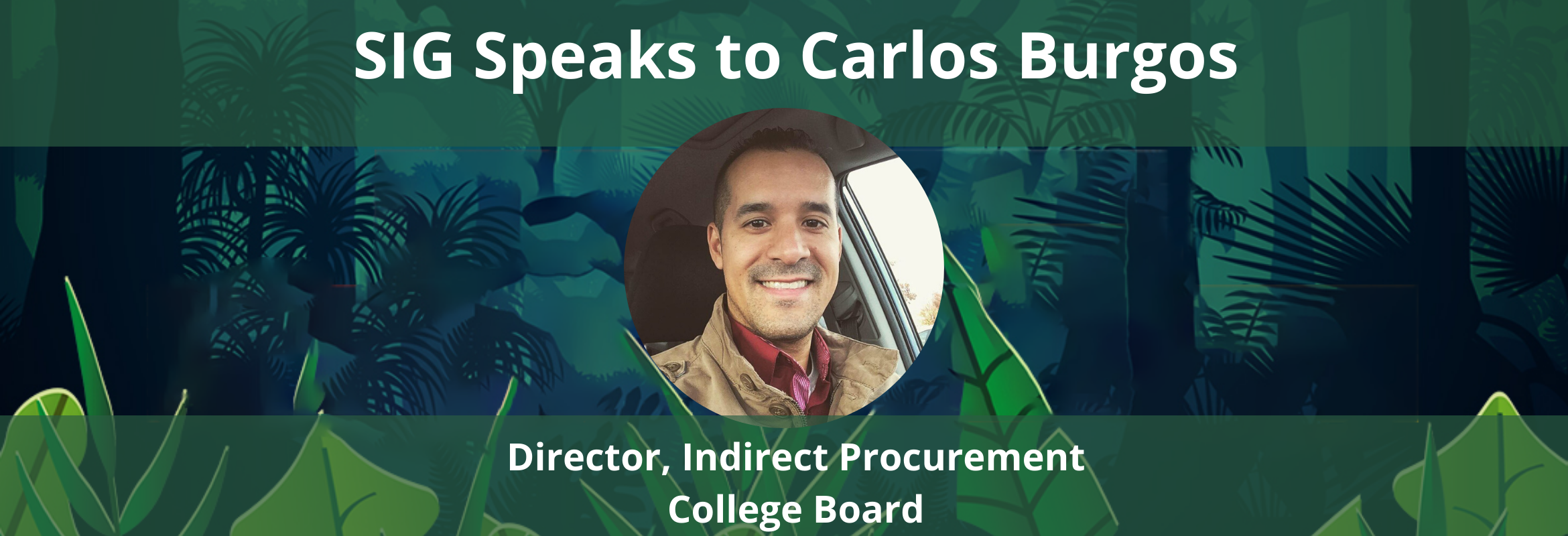
I am Director, Indirect Procurement, and my role is to manage indirect categories of spend. Those categories include office supplies, office equipment, maintenance and repairs, office services, HR and our contingent workforce program, among others.
In my role I strive to reduce dependencies on sole-sourced vendors, automate processes by migrating where possible to a digital delivery, manage down our expenses and leverage our suppliers to come up with solutions that challenge our business operations. At the end of the day, I’m tasked with transforming our operating model to deliver an improved stakeholder experience with greater flexibility and at a lower cost.
What is something that you wish more people knew about sourcing and procurement?
I wish people knew how rewarding this profession is. We get to work on a variety of different projects that are challenging and unique. We get to work with all departments and divisions within our organizations, as well as work with all levels of employees from the CEO to entry-level colleagues. We play an integral part in putting solutions in place that affect our business operations, supply chain and ultimately our viability as a company.
In your opinion, what are 3 skills that sourcing and procurement professionals of tomorrow must have?
The 3 skills that sourcing and procurement professionals of tomorrow must have:
Carlos Burgos, Director, Indirect Procurement, College Board
What is your role and what are your day-to-day responsibilities?
I just transitioned into a new role as Managing Director of North America. We purposefully chose a nebulous title because every day looks different for me and my role is pretty much a catch-all! Some days I'm head-down on internal company strategy (I still lead our client and commercial teams from behind the scenes), other days I work directly with our clients on anything from technology selection projects to jointly running global CPO surveys.
What is something that you wish more people knew about sourcing and procurement?
That it touches EVERYTHING. When I started with Spend Matters 10 years ago, I had no idea that procurement was “a thing.” I wish people thought about how their everyday items from socks to cell phones are made, built, assembled and sourced. I also wish people understood how sophisticated the sourcing and procurement process has the potential to be. It’s so far beyond steak dinners with “key” suppliers and fiddling about with spreadsheets. There's some amazing stuff happening out there with technology and process, and people are thinking bigger to drive it.
In your opinion, what are 3 skills that sourcing and procurement professionals of tomorrow must have?
1) Sales – Hear me out. Procurement is a sales team for a lot of reasons: negotiations internally and externally, selling new internal processes, understanding pain points of teams and suppliers...the list is endless. Being able to “sell” an agenda, a tool, a process or an initiative is key.
Sheena Smith, Managing Director of North America, Spend Matters
What is your role and what are your day-to-day responsibilities?
I wear a lot of hats! I advise practitioner advisory clients on their digital procurement (and broader transformation) initiatives. I particularly like working with Center of Excellence leads! We also serve technology providers and consultants, and I help out with thought leadership (e.g., webinars) and strategy. I lead a team of analysts, but also personally help cover the Contract Lifecycle Management (CLM) space and broader areas in supply chain, risk management, etc.
We’re evangelizing a concept called “Commercial Value Management” that is basically “CLM on steroids.” Finally, I’m responsible for our “Solution Map” provider intelligence benchmark and other market intelligence and product development efforts, and have been spending a lot of time videoconferencing like everyone else!
What is something that you wish more people knew about sourcing and procurement?
It’s so, so much more than cost cutting and doing deals, but rather, about intelligently externalizing the business to safely tap the power of (increasingly digital) supply markets to maximize enterprise value. Yeah, there’s a lot of words in that statement, but it’s true! It’s the ultimate cross-functional and cross-discipline function.
In your opinion, what are 3 skills that sourcing and procurement professionals of tomorrow must have?
The skills that are still required today: business domain knowledge, stakeholder/relationship management, supply management (strategic cost management, negotiations, SRM, SCM, risk management, etc.), market intelligence and change management.
Pierre Mitchell, Chief Research Officer, Spend Matters

 (1).png "Automation Really Isn’t About Automation")
 (1).png "How AI Will Transform Procurement")

.png "8 Steps to Manage Vendor Data Privacy Compliance")



Implementing Innovation
SIG University Certified Sourcing Professional (CSP) program graduate Andrew Frye discusses the importance of implementing technology and innovation into sourcing practices.